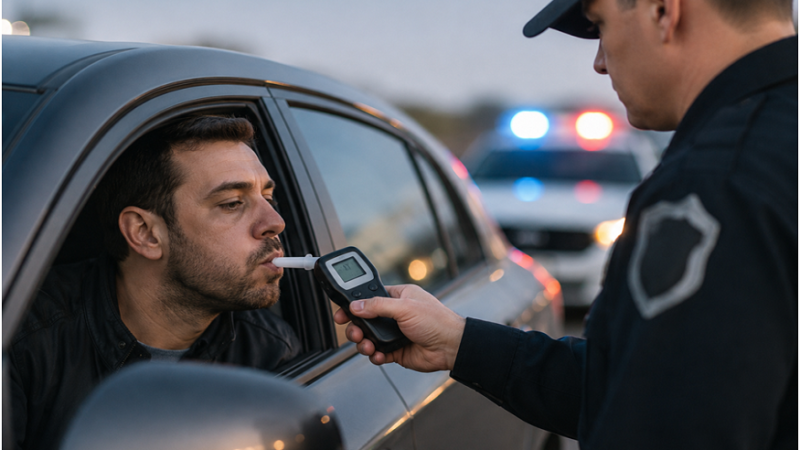
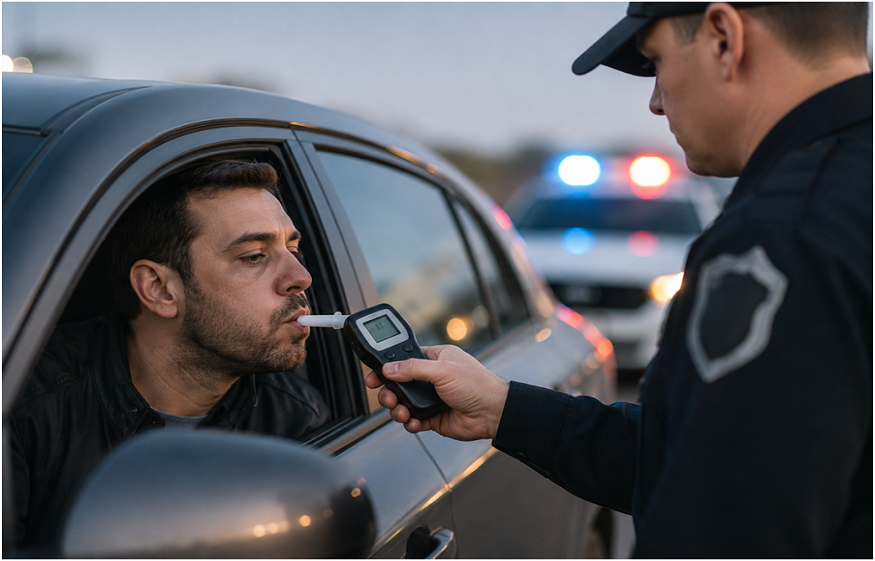
Many drivers assume that a breathalyzer result is necessary for a DWI or DUI charge. After all, if there is no breath test showing that a driver’s alcohol concentration was above the legal limit, how can police prove that the driver was impaired?
The answer depends on the law of the state where the traffic stop occurred, but in many jurisdictions, a breath test is only one piece of evidence in a driving while intoxicated or driving under the influence investigation.
A driver can potentially face a DWI/DUI charge even when there is no breathalyzer result.
A Breath Test Is Only One Type of Evidence
Police investigating suspected impaired driving may collect several types of evidence during a traffic stop.
An officer may document how the vehicle was being operated, what happened when the vehicle was stopped, and how the driver behaved during the encounter. Other evidence may include field sobriety testing, statements made by the driver, video footage, witness accounts, and other forms of chemical testing.
For example, an officer might allege that a driver was:
- Swerving or repeatedly crossing lane markings
- Driving significantly above or below the speed limit
- Nearly causing an accident
- Having difficulty maintaining balance
- Slurring their speech
- Showing other apparent signs of impairment
- Performing poorly during field sobriety exercises
Whether that evidence is sufficient to support a conviction is a separate question. The prosecution generally must establish the elements of the particular offense under the applicable state law.
What If the Driver Refuses the Breath Test?
A driver may refuse to provide a breath sample, although the legal consequences of doing so vary considerably from state to state.
Many states have implied-consent laws that impose consequences for refusing certain types of chemical testing. Those consequences can include driver’s-license penalties and, depending on the jurisdiction, additional legal consequences.
But refusing a breath test does not necessarily end the investigation.
Police may continue to rely on other evidence of suspected impairment. Depending on the circumstances, they may also seek a blood or urine test or another form of chemical testing.
This is one reason drivers should be cautious about assuming that refusing a breath test automatically prevents a DWI or DUI prosecution.
Field Sobriety Tests May Become Important
Field sobriety tests are commonly used when an officer suspects that a driver is impaired.
Standardized field sobriety exercises are designed to evaluate things such as balance, coordination, divided attention, and the ability to follow instructions. An officer may document the driver’s performance and later testify about those observations.
However, roadside testing takes place under real-world conditions rather than in a controlled environment.
Weather, road conditions, lighting, footwear, physical limitations, injuries, fatigue, nervousness, and other factors can potentially affect a driver’s performance.
For that reason, an attorney reviewing a DWI/DUI case may look closely at how the tests were administered, what instructions were given, and what the officer actually observed.
Police Observations Can Also Matter
An officer’s observations may become part of the evidence in a DWI/DUI case.
The officer may testify about the driver’s speech, appearance, coordination, behavior, or alleged odor of alcohol. The officer may also describe statements allegedly made during the traffic stop.
Video can provide another source of evidence. Depending on the circumstances, police body cameras, dash cameras, nearby surveillance cameras, or other recordings may capture portions of the encounter.
The importance of this evidence varies from case to case. An attorney may compare the officer’s written report and testimony with available video or other evidence to determine whether they are consistent.
Can You Be Charged Based on Driving Behavior Alone?
In some circumstances, driving behavior can be an important part of a DWI/DUI investigation.
Erratic driving, leaving the roadway, nearly striking another vehicle, or other unusual conduct may lead an officer to suspect impairment.
But unusual driving does not necessarily establish intoxication or impairment by itself. There can be many explanations for poor driving, including distraction, fatigue, a medical emergency, mechanical problems, unfamiliar roads, or adverse weather.
The significance of particular driving behavior depends on the totality of the circumstances and the requirements of the applicable law.
What About Blood or Urine Tests?
Breath testing is not the only form of chemical testing used in impaired-driving investigations.
Blood or urine testing may be used in certain circumstances, particularly when drug impairment is suspected or when a breath test is unavailable or inappropriate.
These types of testing can involve different procedures and legal requirements. Questions concerning consent, warrants, the collection process, laboratory analysis, and chain of custody can potentially become important.
The rules vary significantly between jurisdictions, so information about chemical testing in one state should not automatically be applied to a case somewhere else.
Read More: Managing Factory Relocation: How to Avoid Expensive Setbacks
Does the Absence of a Breath Test Help the Defense?
It can be an important fact, but it does not automatically determine the outcome.
When there is no breath-test result, an attorney may evaluate what other evidence the prosecution has. The attorney may examine the reason for the traffic stop, the officer’s observations, field sobriety testing, video footage, statements, witness accounts, and any other available evidence.
The question is not simply whether a breathalyzer was used. The larger question is whether the available evidence is sufficient under the law applicable to the particular charge.
State Laws Can Treat DWI and DUI Differently
DWI and DUI laws can vary substantially between states, which is why drivers should be careful when relying on general information about impaired-driving charges.
For example, New York has specific laws addressing driving while intoxicated, including offenses based on alcohol concentration and impairment. Drivers looking for more information about the state’s DWI laws can review this New York DWI resource.
New Jersey has its own rules concerning driving while intoxicated and chemical testing. Although people commonly use the term DUI when referring to driving under the influence in New Jersey, the state’s statutes generally use DWI terminology. Information specific to New Jersey can be found in this New Jersey DWI/DUI resource.
These are simply examples of a broader point: the rules in one state should not automatically be applied to another. The law where the traffic stop occurred is what generally determines the driver’s rights and potential consequences.
Does a Breath Test Guarantee a Conviction?
No.
A breath-test result can be significant evidence, but a DWI/DUI case typically involves more than a single test result.
The circumstances of the traffic stop, the administration of the test, the reliability of the equipment, the officer’s observations, and other evidence can all potentially become relevant.
Likewise, the absence of a breath test does not necessarily mean that a driver cannot be prosecuted.
The Bottom Line
A DWI or DUI case does not necessarily depend on a breathalyzer.
Depending on the circumstances and applicable state law, prosecutors may rely on a combination of driving behavior, police observations, field sobriety testing, video footage, witness testimony, and other chemical tests.
At the same time, the absence of a breath test can be an important part of evaluating a particular case. What matters is the evidence as a whole and whether that evidence satisfies the legal requirements of the jurisdiction.
If you are facing a DWI, DUI, driving while intoxicated, or driving under the influence charge, understanding exactly what evidence exists—and how the law where the traffic stop occurred treats that evidence—is more useful than simply asking whether a breathalyzer was involved.
The Bottom Line
A DWI or DUI case does not necessarily depend on a breathalyzer.
Depending on the circumstances and applicable state law, prosecutors may rely on a combination of driving behavior, police observations, field sobriety testing, video footage, witness testimony, and other chemical tests.
Read More: Applying Custom Motorcycle Decals- What should you know?
At the same time, the absence of a breath test can be an important part of evaluating a particular case. What matters is the evidence as a whole and whether that evidence satisfies the legal requirements of the jurisdiction.
If you are facing a DWI, DUI, driving while intoxicated, or driving under the influence charge, understanding exactly what evidence exists and how the law where the traffic stop occurred treats that evidence is more useful than simply asking whether a breathalyzer was involved.